
AI Customer Service Agent: Transform Your Call Center
The customer service landscape has fundamentally shifted over the past few years. Businesses now face mounting pressure to deliver instant, accurate support around the clock while managing costs and maintaining quality. An AI customer service agent represents a solution that addresses these challenges head-on, transforming how organizations handle customer interactions through intelligent automation and natural language understanding. This technology enables companies to maintain continuous availability, process requests efficiently, and deliver consistent experiences regardless of call volume or time of day.

Understanding the Modern AI Customer Service Agent
An AI customer service agent operates as a sophisticated virtual assistant capable of handling customer interactions through voice or text channels. Unlike simple chatbots of the past, today's agents leverage advanced language models and voice intelligence to understand context, interpret intent, and respond appropriately to customer needs.
These systems integrate directly with business knowledge bases, customer relationship management platforms, and operational workflows. When a customer calls, the AI customer service agent immediately engages, identifies the purpose of the contact, and takes appropriate action-whether that means answering questions, processing transactions, scheduling appointments, or routing complex issues to specialized human team members.
Core Capabilities That Drive Value
Modern AI customer service agents deliver several critical capabilities that distinguish them from previous automation attempts:
Natural conversation flow that adapts to customer communication styles
Intent recognition that identifies what customers need from their own words
Context retention across the conversation to avoid repetitive questioning
Integration with business systems to access real-time information and execute actions
Intelligent escalation that recognizes when human expertise is required
Continuous learning from interactions to improve over time
The technology has matured significantly, with implementations now demonstrating measurable improvements in customer experience metrics and operational efficiency.

Implementation Architecture and Technical Considerations
Deploying an AI customer service agent requires careful attention to architecture and integration patterns. Successful implementations follow structured approaches that balance capability with security and reliability.
System Integration Framework
Integration LayerPurposeKey ComponentsVoice InterfaceCustomer interaction entry pointSpeech recognition, natural language processing, voice synthesisKnowledge BaseInformation retrieval and response generationDocument repositories, FAQ databases, product catalogsBusiness SystemsData access and action executionCRM, scheduling, inventory, ticketingEscalation LogicHuman handoff managementRouting rules, agent availability, context transfer
The integration framework ensures that your AI customer service agent operates as a cohesive part of your customer experience ecosystem rather than an isolated tool. Google Cloud's Contact Center AI solutions provide detailed implementation patterns that demonstrate how these components work together in production environments.
Security and Privacy Architecture
Security considerations extend beyond standard application security when deploying AI systems. The NIST implementation report on RAG-based chatbots outlines specific controls and architectural patterns necessary for secure conversational agents.
Critical security elements include:
Data isolation to prevent information leakage between customer interactions
Access control ensuring the AI customer service agent only accesses authorized information
Audit logging for compliance and incident investigation
Encryption for data in transit and at rest
Model security protecting against prompt injection and adversarial attacks
For organizations operating in regulated industries or serving European markets, privacy protections require additional attention. The European Data Protection Board's guidance on LLM privacy risks provides specific recommendations for GDPR-compliant virtual assistant deployments.
Operational Benefits and Business Impact
Organizations implementing AI customer service agents report transformative changes across multiple operational dimensions. The technology delivers benefits that extend beyond simple cost reduction.
Scalability Without Linear Cost Growth
Traditional call centers face a fundamental challenge: handling more calls requires hiring more agents. An AI customer service agent breaks this linear relationship. Once deployed, the system handles additional volume with minimal incremental cost.
Consider a small business experiencing seasonal demand spikes. During peak periods, call volume might triple while available staff remains constant. The AI customer service agent absorbs the surge, maintaining service levels without overtime costs or the complications of temporary hiring.
Response Time and Availability
Customer expectations for immediate service continue to rise. Research shows that 67% of customers hang up if they can't reach someone quickly. An AI customer service agent eliminates hold times for routine inquiries and operates 24/7/365 without breaks or shift changes.
This continuous availability proves particularly valuable for businesses serving multiple time zones or industries where issues arise outside standard business hours. When a customer calls at 2 AM with a question, they receive immediate assistance rather than encountering voicemail or waiting until morning.

Consistency and Quality Control
Human agents vary in knowledge, experience, and performance. An AI customer service agent delivers consistent responses based on your current business information and policies. Every customer receives the same level of service quality regardless of when they call or how many interactions occur simultaneously.
For organizations with specific features and capabilities built into their customer experience strategy, this consistency ensures brand standards remain intact across every touchpoint.
Use Cases and Application Scenarios
The versatility of AI customer service agents enables deployment across diverse industries and functional areas. Understanding specific use cases helps organizations identify high-value implementation opportunities.
Appointment Scheduling and Management
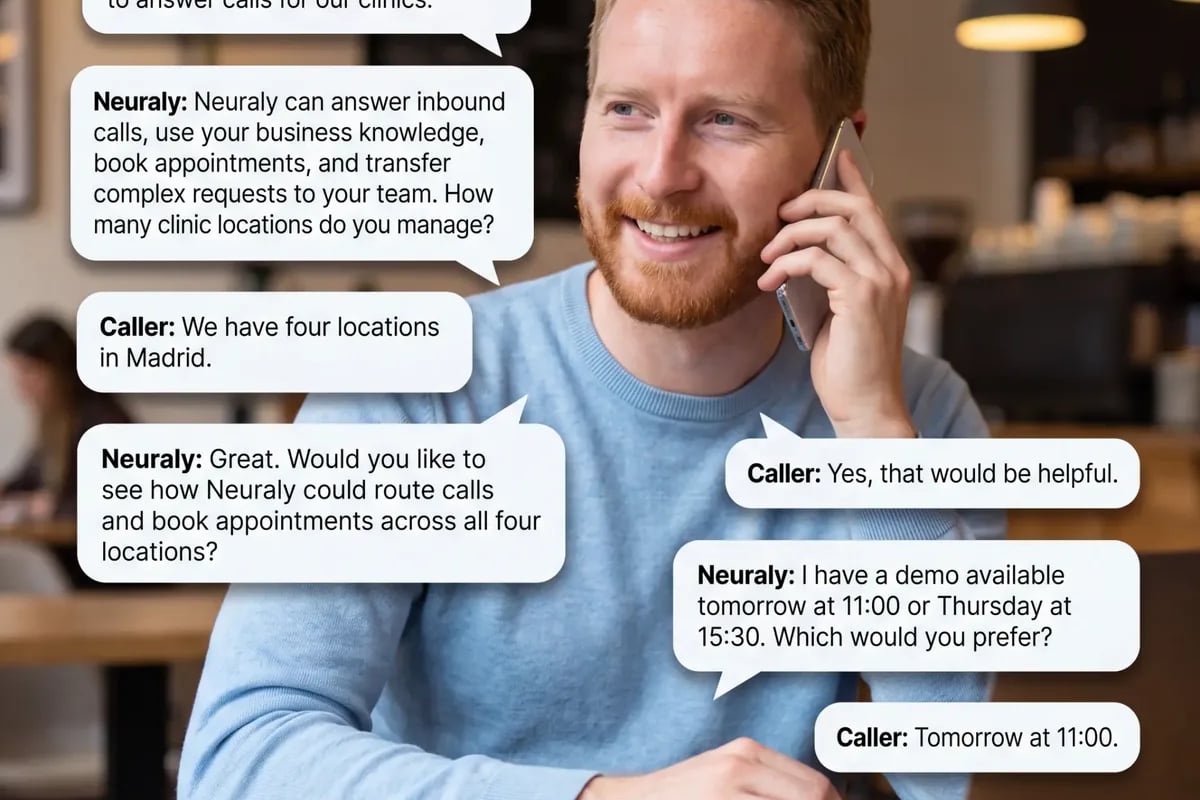
Medical practices, professional services firms, and personal care businesses spend significant time managing appointments. An AI customer service agent handles:
New appointment booking based on provider availability
Rescheduling requests with calendar integration
Appointment confirmations and reminders
Basic pre-appointment instructions
The system accesses real-time calendar data, applies business rules around scheduling windows and appointment types, and updates records automatically.
Order Status and Tracking
Retail and e-commerce operations field constant inquiries about order status. An AI customer service agent connects to order management systems to provide:
Real-time shipment tracking information
Order confirmation and details
Delivery timeline estimates
Basic modification requests within defined parameters
Technical Support Triage
Technology companies and software providers use AI customer service agents for first-level technical support:
Issue identification through conversational troubleshooting
Known solution delivery for common problems
Self-service guidance through fix procedures
Ticket creation with detailed context when escalation is needed
Expert routing to specialists based on issue category
Research on real-world LLM agent assist implementations demonstrates how these systems effectively support both customers and human agents in technical support scenarios.
Information Requests and FAQs
Every business answers repetitive questions about hours, locations, policies, and services. An AI customer service agent maintains this information and delivers accurate responses instantly:
Question CategoryAI Agent CapabilityBusiness ImpactBusiness hours and locationsImmediate accurate responseReduced call volume to human staffProduct availabilityReal-time inventory checkingImproved customer satisfactionPolicy informationCurrent policy deliveryConsistent communicationPricing and quotesRule-based quote generationFaster sales cycle
Small businesses deploying their first automated system often start with these fundamental use cases. A Basic Plan implementation focuses on core inbound call handling and common customer requests, establishing the foundation before expanding to more complex scenarios.
Agent Training and Knowledge Management
The effectiveness of an AI customer service agent depends heavily on the quality and organization of the knowledge it accesses. Successful deployments invest deliberately in knowledge architecture and ongoing maintenance.
Structured Knowledge Bases
Information should be organized in formats that enable efficient retrieval and accurate response generation:
Hierarchical categorization by topic, product, or service area
Frequently updated to reflect current offerings and policies
Version controlled to track changes and enable rollback
Access-controlled to separate public and internal information
Format-optimized for AI retrieval and processing
Continuous Improvement Cycles
AI customer service agents improve through systematic analysis of interactions:
Monitor conversations for accuracy and customer satisfaction
Identify knowledge gaps where the agent lacks information
Review escalation patterns to understand capability limits
Update knowledge base and business rules based on findings
Validate improvements through A/B testing or staged rollout
This cycle ensures the AI customer service agent becomes more capable over time rather than stagnating with initial deployment capabilities.
Hybrid Models and Human Collaboration
The most effective customer service operations leverage AI customer service agents alongside human expertise rather than viewing automation as replacement technology.
Intelligent Escalation Strategies
Sophisticated AI customer service agents recognize situations requiring human judgment:
Emotional complexity when customers express frustration or distress
Edge cases outside established knowledge or procedures
High-value interactions where relationship building matters
Complex problem-solving requiring creative or multi-step reasoning
Policy exceptions that need managerial approval
The escalation mechanism preserves conversation context, transferring relevant information to the human agent so customers don't repeat themselves.
Agent Assist Capabilities
AI customer service agents also support human agents during complex interactions. Real-time suggestions, knowledge retrieval, and process guidance help human agents work more effectively while maintaining personal connection with customers.
Measuring Success and ROI
Organizations need clear metrics to evaluate AI customer service agent performance and justify ongoing investment.
Operational Metrics
Key performance indicators include:
Containment rate: Percentage of interactions resolved without human escalation
Average handle time: Duration of AI-handled interactions
First-contact resolution: Issues resolved in single interaction
Availability metrics: System uptime and response consistency
Volume capacity: Concurrent interactions managed
Customer Experience Metrics
Operational efficiency means little without positive customer outcomes:
Customer satisfaction (CSAT) scores for AI interactions
Net Promoter Score (NPS) impact
Customer effort score comparing AI versus traditional channels
Retention rates for customers primarily served by AI
Complaint patterns and resolution times
The evolving customer service technology landscape emphasizes experience metrics as primary success indicators rather than pure efficiency measures.
Financial Impact
Cost CategoryTraditional ModelAI Customer Service Agent ModelTypical SavingsStaffing (per 1000 monthly calls)$8,000-$12,000$1,500-$3,00070-80%Training and onboarding$2,000 per agentOne-time setup85-90%After-hours coveragePremium pay or third-partyIncluded95%+Scaling costsLinear with volumeMinimal incremental80-90%
Selection Criteria for AI Customer Service Solutions
Organizations evaluating AI customer service agent platforms should assess capabilities across multiple dimensions.
Technical Evaluation Factors
Voice quality and naturalness: Does the system sound robotic or conversational? Can it handle accents, background noise, and natural speech patterns?
Integration flexibility: How easily does the platform connect with your existing CRM, scheduling, inventory, and other business systems? Are pre-built connectors available or is custom development required?
Customization depth: Can you tailor responses, workflows, and decision logic to match your specific business needs? What level of technical expertise is required?
Security and compliance: Does the platform meet requirements for your industry and geography? What certifications and audit reports are available?
Scalability architecture: How does the system perform under peak load? What are the practical limits on concurrent conversations?
Vendor and Support Considerations
Beyond technical capabilities, evaluate the provider organization:
Implementation support and onboarding assistance
Documentation quality and developer resources
Ongoing support responsiveness and expertise
Product roadmap and update frequency
Customer references in similar industries
Pricing transparency and total cost of ownership
For businesses ready to explore implementation, reviewing detailed platform information helps clarify how specific solutions address these evaluation criteria.
Future Developments in AI Customer Service
The AI customer service agent landscape continues evolving rapidly. Understanding emerging capabilities helps organizations plan strategic implementations that remain relevant as technology advances.
Multimodal Interaction
Future systems will seamlessly blend voice, text, and visual channels within single interactions. A customer might start with a voice call, receive a text message with a link or image, and continue the conversation across channels without losing context.
Emotional Intelligence
Advanced sentiment analysis and emotional recognition enable AI customer service agents to detect frustration, confusion, or satisfaction and adjust their approach accordingly. These systems recognize not just what customers say but how they say it.
Predictive Engagement
Rather than purely reactive response, AI customer service agents will initiate contact based on predicted needs. When data indicates a customer might have a question or issue, the system reaches out proactively with relevant information or assistance.
Autonomous Problem Resolution
Current AI customer service agents execute predefined workflows. Emerging systems demonstrate autonomous reasoning that enables them to solve novel problems by combining knowledge in creative ways without explicit programming for every scenario.
These developments promise even greater business value while raising important questions about governance, transparency, and maintaining appropriate human oversight in customer relationships.
AI customer service agents represent a fundamental advancement in how businesses deliver support and engage customers. The technology enables scalability, consistency, and availability that traditional models cannot match while freeing human teams to focus on complex, high-value interactions.
For organizations ready to transform their phone lines into always-on customer experience platforms, Neuraly provides the AI voice intelligence infrastructure to answer calls, understand needs, execute actions, and route complex requests appropriately. Start building better customer experiences today.
#AI #Customer Service